- Home
-
Linear Actuators: Definition, Working Principle& Selection Guide
Views: 0 Author: Site Editor Publish Time: 2026-02-28 Origin: Site


The office standing desk you raise every morning, the automatic liftgate on a car, and the smooth motion of a medical CT scanner all rely on the same essential component: the linear actuator. The name may sound highly technical, but the idea is simple. A linear actuator does one job extremely well: it pushes or pulls an object in a straight line. That focused function has made it one of the most important building blocks in modern automation.
In this article, we will take a closer look at what a linear actuator is, how it works, the main types available, and how to choose the right linear actuator system for a specific project.
What Is a Linear Actuator?
A linear actuator is a mechanical device that converts rotary motion into straight-line motion. A linear actuator delivers push-and-pull movement directly. If a motor is like a wheel turning in circles, a linear actuator is more like a piston moving back and forth.
This straight-line motion makes the linear actuator ideal for tasks such as lifting, pressing, clamping, tilting, and positioning.
A typical electric linear actuator system usually includes a rotary motor (stepper, brush DC or brushless servo) and a threaded lead screw with a precision nut. When the motor is powered on, it generates rotational force.
How Does a Linear Actuator Work?
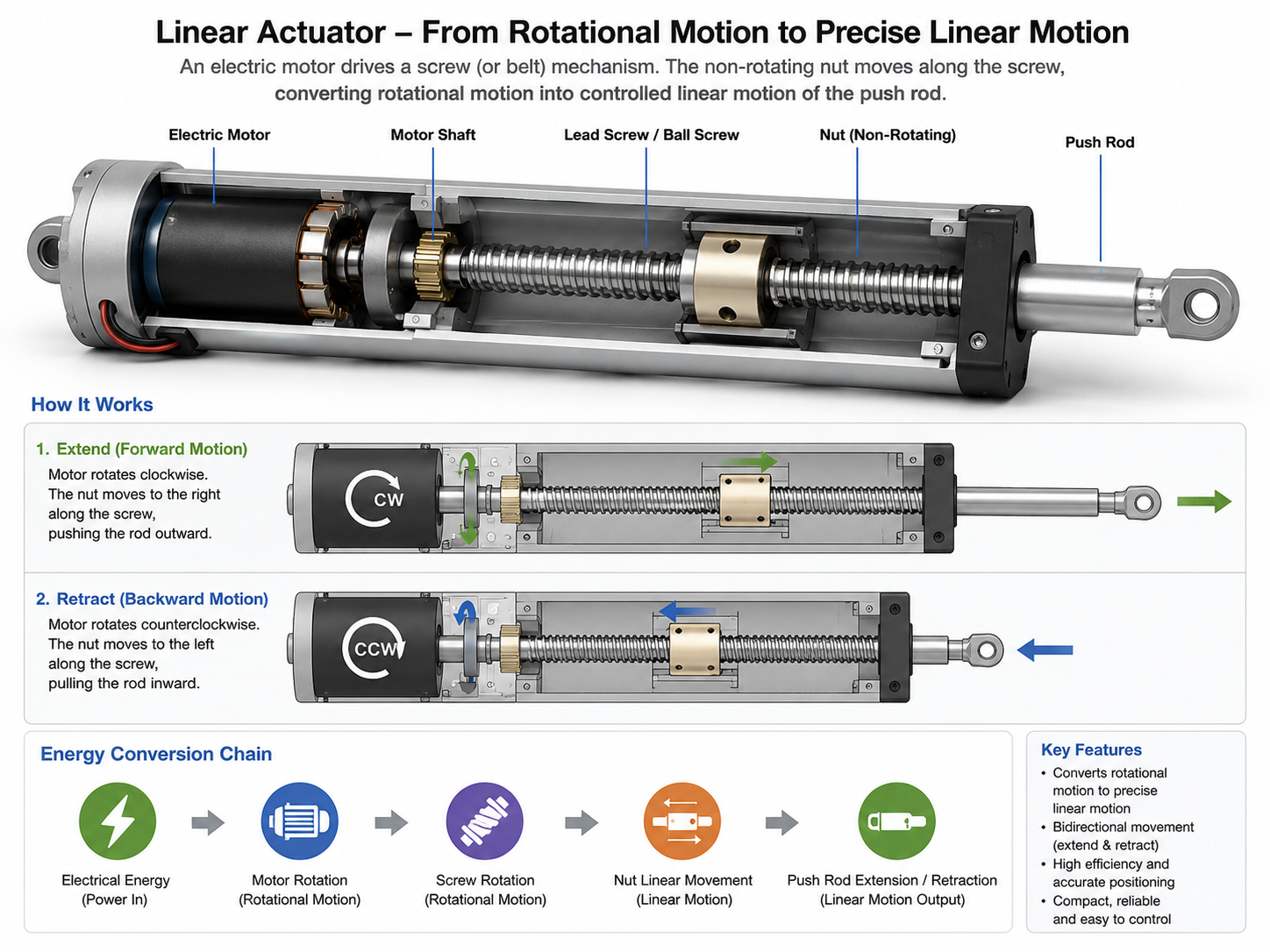
A linear actuator operates by converting the rotational motion generated by an electric motor into precise linear movement. This is achieved through a lead screw or ball screw mechanism, where the motor’s clockwise and counterclockwise torque drives a nut assembly along the length of the screw, producing controlled forward and backward linear motion.
If you open up a typical electric linear actuator, you will see a clear chain of energy conversion. Power enters the system, the motor begins to rotate, and the motor shaft turns a precision screw or, in some models, a belt-driven mechanism. Because the nut is prevented from rotating, it can only move forward or backward along the screw thread. As a result, the push rod extends or retracts, completing a full linear movement cycle.
Main Types of Linear Actuators
Based on the energy source, linear actuators are generally divided into three main categories: electric, hydraulic, and pneumatic. Each one has its own strengths in terms of force, speed, precision, and control, so the right choice depends on the job at hand.
Electric Linear Actuators
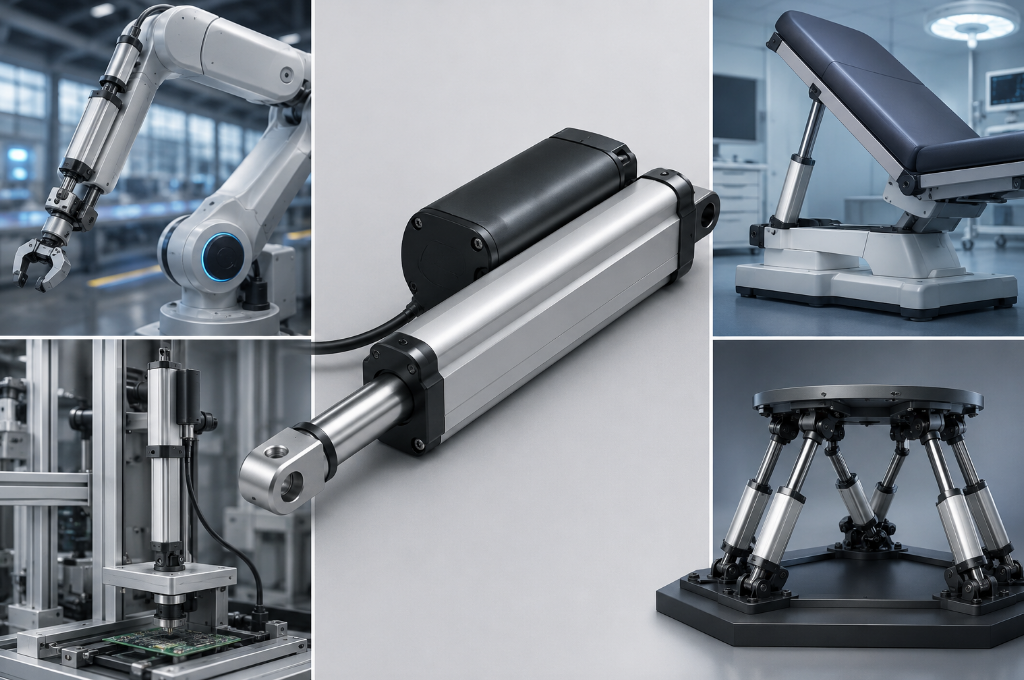
Electric linear actuators are currently the fastest-growing category. They connect to a power source directly and do not require a pump station or compressed air supply. The structure is relatively simple, and integration is easy.
Electric actuators stand out in precision control. They can achieve highly accurate positioning and are ideal for applications that require exact motion paths, such as robotic joints, medical devices, and automated test platforms. They are also quiet, clean, and relatively low-maintenance.
However, electric actuators are not always the best choice for extremely high-force applications, and they depend on a stable power supply.
Hydraulic Linear Actuators
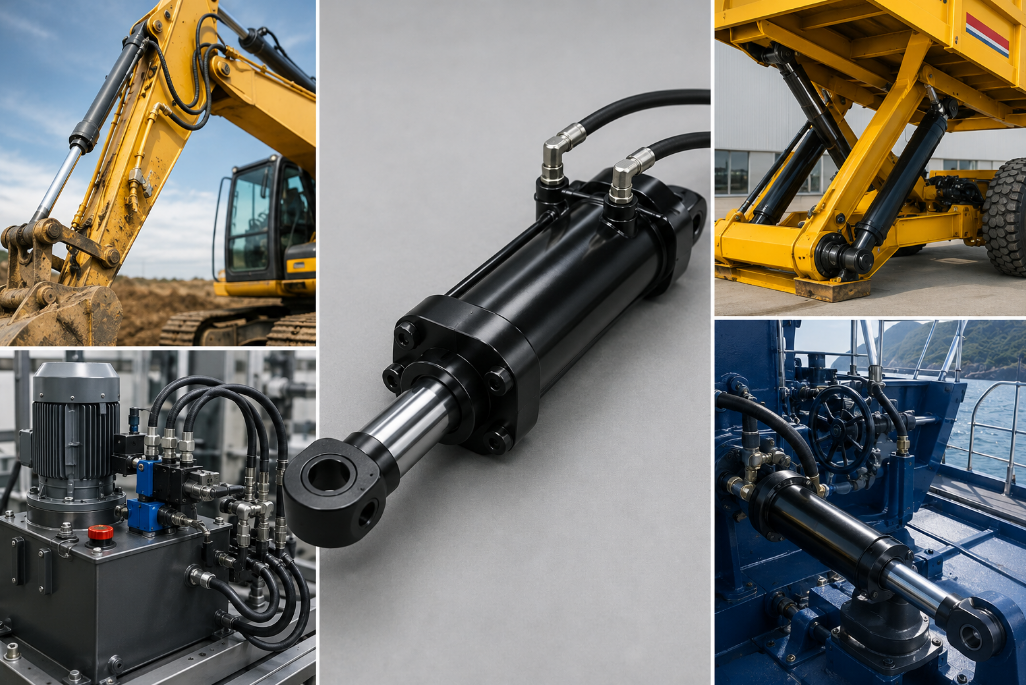
Hydraulic linear actuators use pressurized fluid to drive a piston. Because liquids are essentially incompressible, hydraulic systems can generate enormous force, which is why they are widely used in construction machinery, heavy lifting equipment, and marine steering systems.
Their power density is very high, meaning a compact hydraulic cylinder can move loads of several tons. The tradeoff is that hydraulic systems require a pump, oil reservoir, and piping network, which makes the overall setup larger and more complex to maintain. There is also the risk of fluid leakage.
Pneumatic Linear Actuators
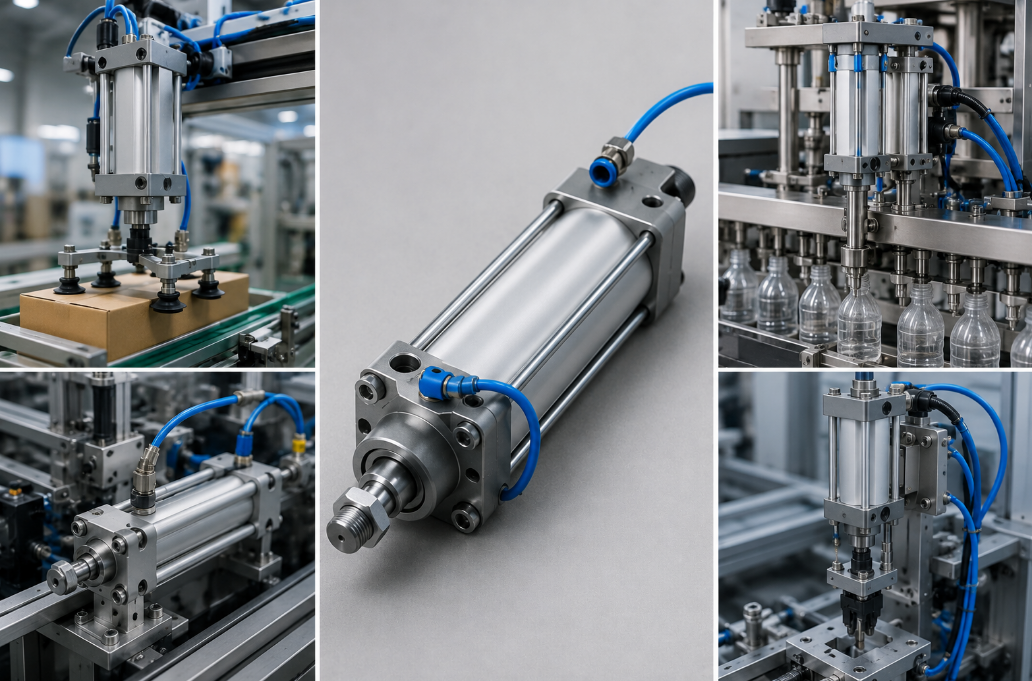
Pneumatic linear actuators use compressed air as the power source. They move quickly, have a simple structure, and are relatively affordable. They are commonly used in packaging machines, automated assembly lines, and food and beverage processing equipment, where rapid back-and-forth motion is often required.
Because air is compressible, however, pneumatic actuators are not as stable as electric actuators when it comes to precision positioning or holding an intermediate position. They are usually best suited for end-to-end motion control.
None of these three drive methods is universally better than the others. The right choice depends on whether your project prioritizes force, speed, accuracy, cost, or maintenance convenience.
Main Types of Electric Linear Actuators
Within the broader category of electric linear actuators, there are several subtypes based on transmission structure and motor type. Each serves a different need.
From a transmission perspective, screw-driven actuators are the most common. These can be further divided into lead screw and ball screw designs. Lead screw actuators have a simpler structure and lower cost, making them suitable for light-duty, low- to medium-speed applications. Ball screw actuators use rolling balls between the screw and nut to reduce friction, which gives them higher efficiency and precision. They are ideal for applications that require frequent starts and stops or very accurate positioning.
Another option is the belt-driven actuator. This design works similarly to the belt system in a printer. It is a good fit for long travel distances, moderate precision, and faster movement.
From a motor standpoint, there are several options as well. DC brushed motor actuators are affordable and easy to control, which makes them common in consumer products and general industrial equipment. Stepper motor actuators can be controlled with pulse signals for open-loop positioning and are well suited to precise point-to-point motion. Servo motor actuators represent a higher-performance solution, offering closed-loop control and fast response. They are often used in advanced automation, CNC machines, and robotics where dynamic performance matters.
A special form of this category is the electric push rod, which is essentially a more integrated linear actuator. It combines the motor, gearbox, and screw mechanism in a compact housing. The result is a clean design and easy installation, making it popular in solar tracking systems, ventilation windows, agricultural machinery, and other outdoor or high-protection applications.
Where Are Linear Actuators Used?
Linear actuators are widely used across modern industries and smart living environments because they provide precise, reliable, and controlled linear motion. As a global motion solutions provider, JIECANG develops electric linear actuator systems for applications ranging from industrial automation to healthcare, smart office solutions, home furniture, and intelligent mobility systems.
In industrial automation, linear actuators are essential for improving efficiency and reducing manual labor. On automated production lines, JIECANG linear actuators are used for lifting, pushing, positioning, sorting, and material handling. They help machines perform smooth and accurate movements in assembly systems, packaging equipment, logistics conveyors, and robotic automation. With stable performance and intelligent control, electric linear actuators support high-speed manufacturing while maintaining precision and safety.
In the healthcare industry, medical linear actuators play a critical role in improving patient comfort and operational accuracy. According to applications shown on JIECANG Medical Solutions, they are commonly integrated into adjustable hospital beds, nursing beds, patient lifts, treatment chairs, CT/MRI equipment, and rehabilitation devices. Their quiet operation and precise positioning allow medical equipment to move smoothly while meeting strict safety standards.
For smart office environments, JIECANG Standing Desk Solutions demonstrate how lifting columns and linear actuators are transforming modern workplaces. Height-adjustable desks powered by electric actuators allow users to switch easily between sitting and standing positions, improving ergonomics, reducing fatigue, and supporting healthier working habits. These systems are now widely used in offices, home workspaces, conference rooms, and educational environments.
In smart home and furniture applications, linear actuators are increasingly becoming part of everyday life. JIECANG actuator systems are used in adjustable beds, recliner sofas, lift-top coffee tables, TV lifts, kitchen storage systems, and smart curtain solutions. Their compact structure and smooth motion control make furniture more intelligent, comfortable, and user-friendly. You can also see actuator technology integrated into smart home automation systems that improve convenience and space efficiency.
The automotive sector is another major application area for electric linear actuators. They are commonly used in power seat adjustment systems, automatic liftgates, sunroof systems, steering mechanisms, and RV equipment. JIECANG motion systems help enhance vehicle comfort, automation, and user experience while maintaining durability under demanding operating conditions.
Although these applications vary greatly, they all depend on the same core function: converting electrical energy into smooth, controlled, and dependable linear motion. Whether in industrial automation, medical equipment, smart office systems, or intelligent home furniture, linear actuators have become a key technology driving modern motion control solutions.
How to Choose the Right Linear Actuator?
With so many models on the market, how do you choose the right one? The key is not to find the “best” actuator, but the one that fits your application most closely. You should evaluate your needs across several factors.
1. Determine the Required Force
First, define how much weight or resistance the actuator needs to push or pull. Force is usually measured in newtons (N) or kilogram-force (kgf). If the actuator will be used vertically, make sure to include gravity in your calculation. As a general rule, it is wise to leave 20% to 30% extra force margin so the actuator does not run at its maximum load all the time.
2. Confirm the Stroke Length
Stroke refers to the total distance the actuator travels from fully retracted to fully extended. Choose the stroke based on the actual motion range your project requires, and check whether there is enough installation space. The longer the stroke, the higher the demand on screw rigidity and guidance stability.
3. Define the Speed Requirement
You should know how long it should take for the actuator to move from point A to point B. That helps determine the required speed, usually measured in millimeters per second (mm/s). Keep in mind that in most actuators, speed and force are a tradeoff. Higher speed usually means lower force, so a balance is often necessary.
4. Consider Precision and Repeatability
If your application requires the actuator to stop at a specific intermediate position, or repeat the same motion path over and over, precision and repeatability become critical. In that case, you may need a servo-driven actuator with encoder feedback, or at least a stepper motor solution with position sensing.
5. Evaluate the Operating Environment
Temperature, humidity, dust, and chemical exposure all affect actuator selection. Outdoor applications or food processing environments often require an IP65 rating or higher. Indoor applications in clean environments may not need the same level of protection.
6. Do Not Overlook the Control Method
Will you control the actuator with a simple switch, or do you need to connect it to a PLC or computer for more advanced motion control? A basic DC actuator is enough for simple extend/retract commands, while more complex applications may require a smart actuator that supports protocols such as CAN bus, Modbus, or pulse control.
JIECANG Linear Actuator Product
Industrial Linear Actuators
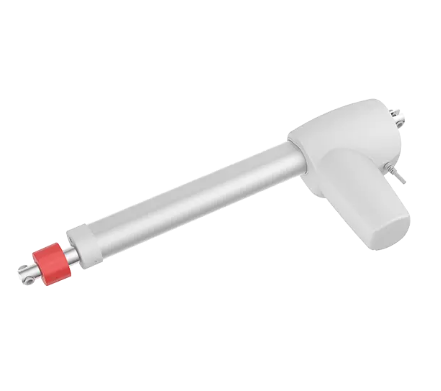
JC35L11: Our flagship heavy-duty model, max thrust up to 12,000N (1.2 tons), stroke range 50-400mm, built for extreme lifting applications.
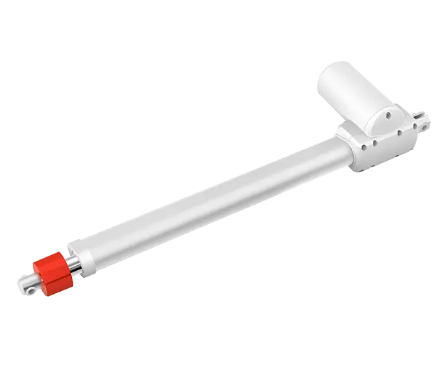
JC35L28: Heavy-duty industrial actuator, 24V/29V DC input, max load 10,000N, optimized for rugged working environments.
Medical & Care Linear Actuators
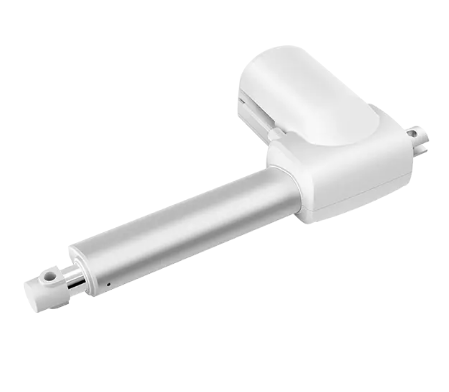
JC35L18: High-speed medical actuator, max load 8000N, supports 24V/29V/36V DC input, optimized for fast, reliable patient care adjustments.
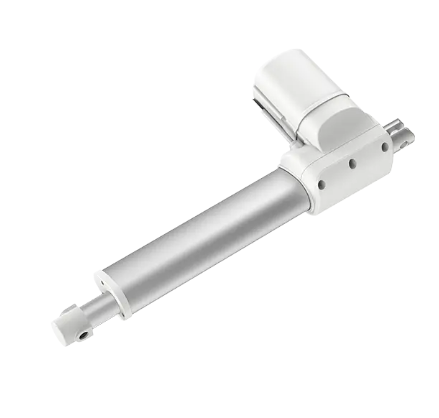
JC35L30: Heavy-duty medical-specific actuator, 24V/29V DC input, stroke range 50-300mm, built for bariatric care and heavy-duty medical equipment.
Small & High Speed Linear Actuators
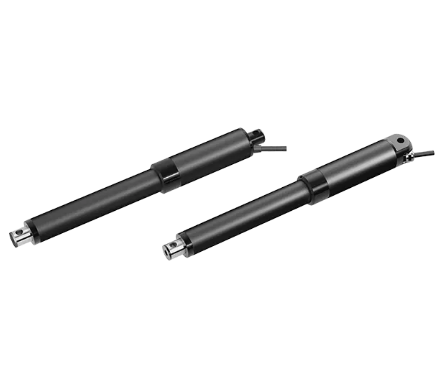
JC35N6 : Micro/miniature linear actuators, optimized for compact spaces, stroke range 30-300mm, ideal for hidden smart home installations.
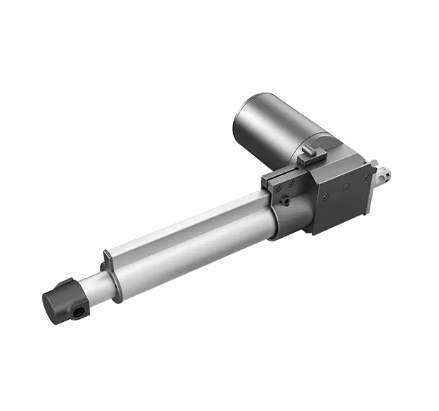
JC35D1: High-speed electric actuators, stroke range 50-600mm, delivering fast, responsive movement for adjustable furniture and automation.
Why Is More Equipment Switching to Electric Linear Actuator Systems?
One clear trend in industrial automation and smart equipment is the move from hydraulic and pneumatic systems to electric linear actuator systems. There are several reasons for this shift.
The first is energy efficiency. Electric actuators consume power only when moving, while hydraulic systems often need a pump running continuously. The second is cleanliness. Electric systems do not carry the leakage risk of hydraulic oil, nor do they create the exhaust noise or oil mist associated with pneumatic systems. That matters a great deal in medical, food, and electronics manufacturing environments.
Another major advantage is digital control. Electric actuators can integrate easily with industrial IoT and smart manufacturing systems, allowing remote monitoring and predictive maintenance. That is much harder to achieve with traditional hydraulic or pneumatic setups.
Of course, this does not mean hydraulic and pneumatic systems are obsolete. In extremely high-force or ultra-high-speed applications, they still have clear advantages. But for most light- to medium-duty industrial uses and consumer products, the electric linear actuator system is becoming the preferred choice because it is precise, clean, and easy to integrate.
Conclusion
A linear actuator may look like a simple motion component, but behind the scenes it powers countless conveniences from factories to homes. Understanding how it works, knowing the differences between actuator types, and learning how to choose the right model can help you make better project decisions and better understand the devices you use every day.
The next time you press a button and see a desk rise smoothly or a car trunk close automatically, you may think of the small device inside quietly turning rotation into straight-line motion.
FAQs
1.What is a linear actuator system and what core function does it perform?
A linear actuator system is a mechanical assembly that converts rotary motion into controlled straight-line motion. Its core function is to deliver precise push-and-pull movement, making it essential for tasks like lifting, pressing, clamping, tilting, and positioning across countless applications from standing desks to medical equipment.
2.What are the key differences between electric, hydraulic, and pneumatic linear actuator systems?
Electric systems offer superior precision, quiet operation, and easy integration with digital controls but are less ideal for extremely high-force applications. Hydraulic systems generate enormous force with high power density but require complex pump and piping setups and carry leakage risks. Pneumatic systems are fast and affordable but lack the precision for intermediate positioning due to air compressibility.
3.What factors should I consider when selecting the right electric linear actuator system for my project?
When choosing an electric linear actuator system, evaluate six critical factors: required force (with a 20-30% safety margin), stroke length matching your motion range, speed requirements (noting the speed-force tradeoff), precision and repeatability needs, operating environment conditions (IP rating), and the desired control method (from simple switches to advanced PLC integration).
4.Why are more industries switching from traditional hydraulic and pneumatic systems to electric linear actuator systems?
The shift to electric linear actuator systems is driven by three main advantages: higher energy efficiency (consuming power only when moving), greater cleanliness (no fluid leakage or exhaust), and seamless digital integration with industrial IoT and smart manufacturing systems for remote monitoring and predictive maintenance.
5.What are some common applications of JIECANG electric linear actuator systems?
JIECANG electric linear actuator systems are widely used across multiple industries: industrial automation for production line lifting and positioning, healthcare for adjustable hospital beds and medical equipment, smart offices for height-adjustable standing desks, smart homes for adjustable furniture and TV lifts, and automotive for power seats and automatic liftgates.