- Home
-
What is the Duty Cycle in a Linear Actuator?
Views: 0 Author: Site Editor Publish Time: 2026-07-01 Origin: Site


When shopping for an electric linear actuator, most buyers prioritize force, stroke length, and speed — but overlook one of the most critical specifications for long-term reliability: duty cycle. Misunderstanding or exceeding duty cycle is one of the top causes of premature actuator failure, even when the load rating is correctly matched.
What Exactly Is Linear Actuator Duty Cycle?
Duty cycle is a percentage that measures the amount of time an actuator can safely operate (run time) within a single full work cycle, relative to the total cycle time (run time + cool-down time).
In simpler terms, it tells you how long you can run the actuator continuously before it must shut off to cool down and prevent overheating. Electric linear actuators generate heat as their motors and gear trains operate; if heat builds up faster than it can dissipate, internal components degrade, windings can burn out, and the unit will fail prematurely.
For example, a linear actuator rated for 20% duty cycle on a 10-minute cycle can run for 2 minutes straight, then requires 8 minutes of idle cool-down time before the next operation cycle.
How to Calculate Linear Actuator Duty Cycle
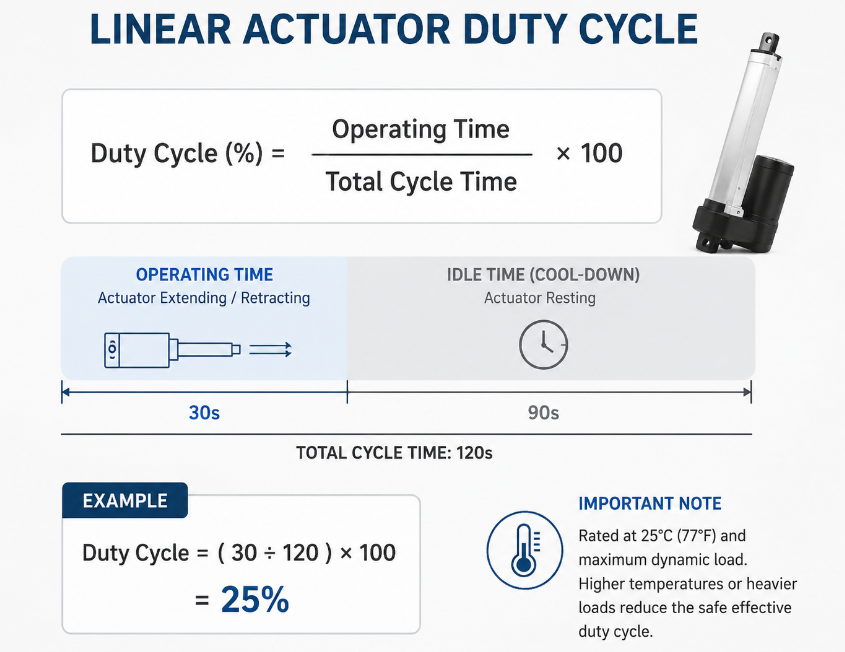
Calculating duty cycle uses a straightforward formula based on operating time and total cycle time:
Duty Cycle (%) = (Operating Time ÷ Total Cycle Time) × 100
Operating time: The total time the actuator is actively extending or retracting under load during one cycle.
Total cycle time: The full duration of one work cycle, including both operating time and the required cool-down idle time.
Example Calculation
If an actuator runs for 30 seconds to lift a load, then rests for 90 seconds before the next cycle:
Operating time = 30 seconds
Total cycle time = 30 + 90 = 120 seconds
Duty cycle = (30 ÷ 120) × 100 = 25%
Important Note: Manufacturers typically rate duty cycle at room temperature (25°C / 77°F) and at the actuator’s maximum rated dynamic load. Higher ambient temperatures or heavier loads will reduce the safe effective duty cycle, so always build in a safety buffer for real-world use.
Why Duty Cycle Matters for Every Project
Ignoring duty cycle specifications can lead to costly downtime, equipment damage, and safety risks. Here’s why this parameter deserves careful attention during the selection process:
Prevents premature motor failure: Overrunning the actuator past its duty cycle causes excessive heat buildup, which breaks down motor winding insulation and leads to permanent burnout.
Preserves warranty coverage: Most actuator warranties do not cover damage caused by exceeding rated duty cycle, as it is considered improper use.
Ensures consistent long-term performance: Operating within duty cycle limits keeps internal components within safe temperature ranges, reducing wear on gears, lead screws, and nuts for a longer service life.
Reduces safety hazards: Overheated actuators pose risks of electrical shorts, melted housing components, and even fire in extreme cases.
Duty cycle is one of several critical specifications to evaluate alongside force, stroke, and IP rating when selecting an actuator.
Key Factors That Affect Actuator Duty Cycle
A linear actuator’s rated duty cycle is not a fixed number under all conditions. Several real-world factors will increase or decrease the safe operating window:
1. Applied Load
Heavier loads draw more current from the motor, generating more heat at a faster rate. Operating at 100% of the rated dynamic load will result in the shortest safe run time, while operating at a lower load (e.g., 50% of rating) reduces heat output and allows for a higher effective duty cycle.
2. Ambient Temperature
High ambient temperatures slow heat dissipation from the actuator’s motor and housing. In hot environments or enclosed spaces with poor airflow, you must derate the duty cycle to avoid overheating. Conversely, cooler operating conditions can slightly extend safe run time.
3. Speed & Gear Ratio
Faster actuators use lower gear reduction ratios, which means the motor spins faster per inch of travel, generating more heat in less time. For the same motor size, a high-speed linear actuator will always have a lower duty cycle rating than a high-force, lower-speed model.
4. Enclosure & IP Rating
Higher IP-rated actuators feature tightly sealed housings to protect against dust and water ingress. While this improves environmental durability, it also reduces airflow and heat dissipation from the internal motor. As a result, fully sealed IP66 actuators typically have slightly lower duty cycle ratings than vented or lightly sealed indoor models.
Common Duty Cycle Myths & Mistakes to Avoid
Myth 1: “100% duty cycle means I can run the actuator nonstop forever.”
A 100% continuous duty rating means the actuator can run repeatedly without required cool-down time when operated at its rated load and ambient temperature. It does not mean the unit will never wear out — all mechanical components experience normal wear over time. Running a continuous-duty actuator above its rated load will still cause overheating and failure.
Mistake 1: Using intermittent-duty actuators for constant-use applications
Standard consumer and light industrial linear actuators are designed for intermittent use (typically 10-30% duty cycle). Using them for applications that require near-constant operation — such as conveyor adjustments or continuous positioning systems — will lead to rapid failure. For these use cases, select a purpose-built continuous-duty industrial actuator.
Mistake 2: Ignoring duty cycle for “rare use” projects
Even if your project only operates occasionally, a single extended run that exceeds the actuator’s maximum continuous run time can cause enough heat buildup to damage the motor. Always check the manufacturer’s maximum single-cycle run time, not just the percentage rating.
Tips to Maximize Duty Cycle & Extend Actuator Life
You can improve effective duty cycle and get longer service life from your linear actuator with these best practices:
1. Size with a load safety margin: Select an actuator with a dynamic load rating 25-50% higher than your actual application load. This reduces motor strain, lowers heat output, and allows for longer safe run times.
2. Ensure adequate airflow: Mount actuators in well-ventilated areas whenever possible. Avoid fully enclosing them in tight, unventilated spaces that trap heat.
3. Operate within temperature limits: Never use the actuator outside of its rated operating temperature range. For high-heat environments, derate the load and duty cycle accordingly.
4. Maintain proper alignment: Misaligned mounting causes binding and side loading, which force the motor to work harder and generate excess heat. Always align the actuator perfectly with the direction of load travel.
5. Avoid hard stops: Running the actuator into a hard physical stop stalls the motor, causing a sudden spike in current and heat. Always rely on built-in limit switches to stop travel at end positions.
Conclusion
Duty cycle is a make-or-break specification that determines whether your linear actuator will deliver reliable, long-term performance or fail prematurely. By understanding how to calculate it, what factors impact it, and how to operate within safe limits, you can select the right actuator for your application and maximize its service life.
Proper mounting alignment also reduces unnecessary strain on the motor and lead screw, lowering heat output during operation. To explore more technical concepts, real-world application examples, and step-by-step selection tips for electric linear actuators, browse our full linear actuators guide.